
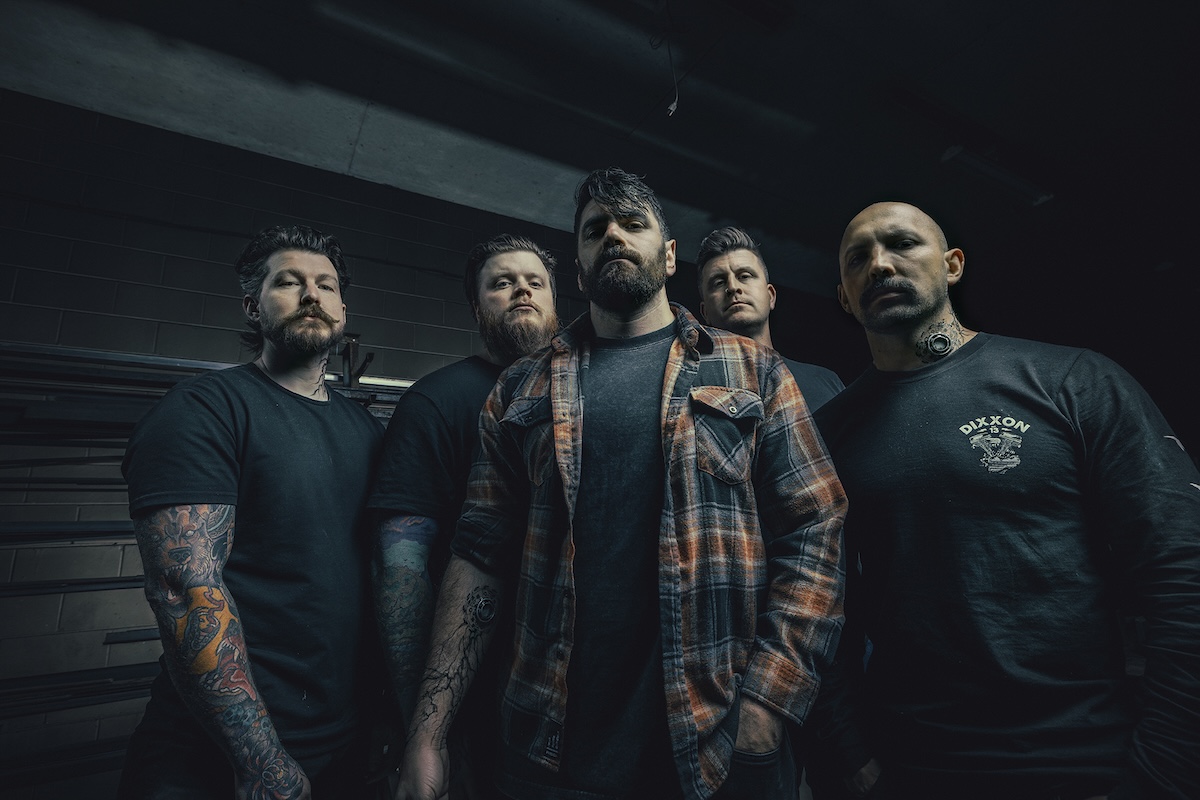
It’s easy to get stuck in your head. Your thoughts become all-consuming, and you easily retreat into your own world. It happens to everyone, yet this internal place often never sees the light of day. However, Wolves At The Gate explore these spaces on their sixth full-length album, Wasteland [Solid State]. The quintet—Steve Cobucci [clean vocals, guitar], Ben Summers [bass], Nick Detty [lead vocals, keys], Abishai Collingsworth [drums], and Joey Alarcon [lead guitar]—pierce the surface and fearlessly plunge into the psyche. They soundtrack this journey with an unpredictable and undeniable hybrid of technically proficient metal, gut-punching hardcore, and arresting alternative melodies accented by entrancing electronic transmissions.
“I’m constantly in my head,” affirms Steve. “Over the years, I’ve realized we each have a world in our minds that we don’t necessarily share with everybody else. I thought, ‘How could I make a story about these worlds in our heads?’ I captured a lot of it from myself, put everything into the music, and started to connect the pieces. I’m definitely taking these internal dialogues and placing them in the songs.”
Wolves At The Gate have quietly and naturally evolved since their emergence out of the Midwest in 2008. Their vision unfolded across albums such as Captors [2012], VxV [2014], Types & Shadows [2016], Eclipse [2019], and Eulogies [2022]. Blabbermouth rated the latter “9.0-out-of-10.0,” while mxdwn summed it up as “powerfully moving.” Along the way, the group tallied tens of millions of streams fueled by the likes of “Counterfeit,” “Deadman,” “Lowborn,” “Peace That Starts The War,” and more. Not to mention, they’ve performed alongside everyone from The Red Jumpsuit Apparatus and Red to Fit For A King, August Burns Red, and Born Of Osiris. In 2024, a core idea screamed out to Steve, shaping the creative direction of the band’s next evolution. It slowly, but surely seeped into the DNA of the music and his words…
“As I was working on the album and especially the lyrics, I began to realize that the Wasteland was a metaphor for a frame of mind that I don’t want to live in, but a world I feel myself drawn back into over and over again,” he reveals. “I hate it. It’s a world of empty promises. It’s a mirage. A counterfeit.”
The musicians carefully pieced together what would become Wasteland. Steve co-produced the 13-track body of work with Josh Gilbert of Spiritbox, while the guys recorded in New Jersey, San Diego, and Los Angeles. This time around, they added multiple dimensions to their signature sound, layering intriguing interludes and electronic overtures into the framework.
“I spent a lot of time watching producers in different genres,” says Steve. “I learned so much, and I was inspired by the creativity of guys like Andrew Huang. Being a standard drums, bass, guitar, and vocals band, it’s helpful to find inspiration from leftfield. Simultaneously, I tried to go back to the basics for songwriting. At the beginning, everything was just me and an acoustic guitar. We challenged ourselves to incorporate a lot of new elements like the interludes and complex intros.”
The first single “Parasite” harnesses this renewed energy. Synths squeal through a barrage of pummeling drums, chugging guitars, and pit-splitting breakdowns. The vocals echo this feeling of uncontainable turbulence, alternating between guttural growls and hypnotic hooks. The central chorus practically draws blood, “Listen to the devil speak, filling my veins with what I seek. And the venom tastes of your deceit, listen to the doublespeak.”
“For ‘Parasite,’ I wanted to capture this dynamic of looking in the mirror and transcribing what I see,” he goes on. “When we see ourselves, we all have character traits that we wish were different. It’s almost like an unconquerable enemy inside of you. You can’t stand its presence, but you keep falling for it. The song tackles the relentless cycle and the frustration. By the end, you just invite the same problem to come back and cause havoc in your life.”
“Synthetic Sun” tempers a rumbling guitar-driven groove with glitchy beat-craft. It climaxes on the chantable chorus, “Cuz we are the children born in the dead of night. Living in the dark we all just kill the light.”
“As a culture, we’re trying to create our own morality, but can’t do so without a true moral standard,” he observes. “Rather, we do this individually, which ends up creating chaos. We all fall prey to this mindset. Creating your own morality will cause you to block out any semblance of a truth outside of yourself. If you metaphorically block out the actual sun and create a synthetic sun, it will result in a slow and fatal poisoning.”
“LAW OF THE [Waste]LAND” leans into a bouncy cadence fueled by seesawing riffs, tense keys, and throat-shredding screams. “It’s both a recognition of reality and a bit of a lament for the world we live in,” he sighs. “It goes back to the concept of ‘eye for an eye’. When you get to the end, it asks, ‘Why do we live like this?’”
Then, there’s “SMOKE [False Devils].” A menacingly cinematic soundscape belies the intensity of an incisive and incendiary proclamation, “Your words cut me deeper. They’re sharper than steel. My tongue fills with fire burning me to the bone. Flames ignite. Tongues ablaze. Smoke devours.”
“When somebody is ‘Blowing smoke,’ it’s a way of being deceitful, lying, or hiding,” he goes on. “Nobody wants to get found out or exposed. At times, it’s pretty clear I screwed up or I didn’t respond well. I hate the defense mechanism that wants to rise up and defend myself—even if I’m indefensible. We’re trying to hide what we already know is true, but we’re not fooling anyone. Instead, accept those weaknesses, faults, flaws, and failures.”
“Death Clock” sets off a ticking time bomb. Breathy verses bottle overwhelming anxiety until it overflows on a hummable chorus amplified by a caustic and catchy call-and-response, “Death clock spinning along in my mind.”
“It describes the world inside of your head,” he continues. “Everyone undoubtedly thinks about death. The song is just being honest when it comes to the fact we all die and how it makes us feel. We wanted it to sound like you’re racing against a clock.”
Through it all, Wolves At The Gate peel back the layers and explore the often-volatile internal interplay of thoughts and emotions. Ultimately, all of this inner work leads to a clearer sense of external understanding.
“It’s incredible what goes on in the mind,” he says. “Most people live what seem to be simple and ordinary lives, but there are countless battles and struggles that descend upon our minds. From the outside, life must seem plain and benign if someone looked at my life, but there is warfare and turmoil going on—thoughts of life, death, pain, and peace as well as depression and joy. It is a wonder that everyone in this world doesn’t collapse under the weight of what this life brings. We all can just tend to live like we just are fending off the dark, with whatever vice or temporary comfort we may choose. If the scales were lifted from our eyes and we stopped desensitizing ourselves for a minute we would find that we live in a world that is unlivable. What gives you hope? What brings you peace? Is there hope in the Wasteland? It appears that there isn’t, but in order to see it we must look outside the Wasteland.”
In the end, Wolves At The Gate might just incite a conversation with Wasteland.
“I hope the songs inspire you to think about what goes on in your mind,” he leaves off. “These songs give a voice to those internal thoughts and struggles. Maybe the album shakes listeners into thought about deeper truths, belief, and, ultimately, finding hope.”